


Men's summer mountain packing guide
What to pack for the mountains in summer: layers for changing weather
Summer in the mountains can bring cool mornings, strong sun, wind, rain and a noticeable drop in temperature after sunset. A useful suitcase is built around light layers that can be added or removed rather than one heavy garment for every possible condition.
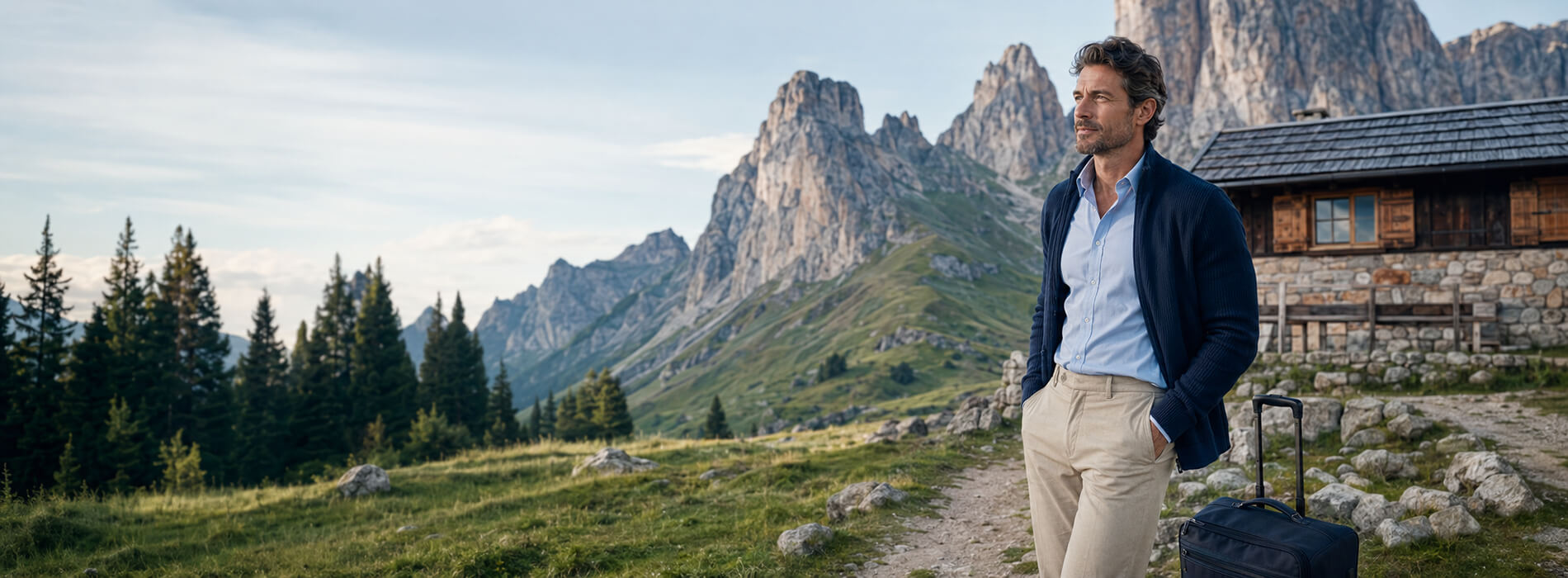
Altitude and programme change the list
A stay in a village at moderate altitude is different from days spent above 1,500 metres. Check minimum and maximum temperatures for the places you will actually visit, not only the hotel. Consider whether the programme includes town walks, easy trails, refuges, restaurants or more technical outdoor activities.
This guide covers general leisure clothing. Technical hiking, climbing and severe-weather activities require dedicated equipment selected for the route and conditions.
The three-layer principle
1
Base layer
A breathable shirt, polo or top that remains comfortable during movement.
2
Warm layer
A light knit or similar garment that can be added in the morning and evening.
3
Weather layer
A suitable outer layer for wind or rain, chosen according to the forecast and activities.
Suggested quantities for 3, 5 or 7 days
| Garment | 3 days | 5 days | 7 days |
|---|---|---|---|
| Breathable shirts or polos | 2–3 | 3–4 | 4–5 |
| Long trousers | 2 | 2–3 | 3 |
| Shorts | 1 | 1–2 | 2 |
| Light warm layers | 1 | 1–2 | 2 |
| Weather-resistant outer layer | 1 | 1 | 1 |
Outfits for common mountain plans
Cool morning
Long-sleeved shirt, full-length trousers and a light warm layer.
Sunny afternoon
Breathable shirt or polo, comfortable trousers or shorts and sun protection.
Refuge or village lunch
A clean casual shirt and trousers provide comfort without looking overly technical.
Evening
Add the warm layer again and choose full-length trousers as temperatures fall.
Fabrics, fit and movement
Lightweight cotton and breathable fabrics work well for general leisure use. Stretch may improve movement, but it should not compensate for a waistband, shoulder or thigh area that is fundamentally too tight. Check how the garment feels while sitting, walking and reaching.
For travel days or dinners, a non-iron shirt can provide a more orderly appearance with practical care, while the outdoor portion of the trip may require more specialised garments.
Final weather checklist
- Minimum and maximum temperature at the actual altitude.
- Rain probability and wind exposure.
- Activities that require technical equipment.
- One extra dry layer kept separate from damp clothing.
- Footwear already tested for the planned walking distance.
- Care instructions for every garment packed.
Frequently asked questions
Do I need heavy clothes in the mountains in summer?
Not necessarily. For many leisure trips, several light layers are more adaptable than one heavy item. The correct choice depends on altitude, forecast and activity.
Are shorts enough during the day?
They may be suitable in warm, sheltered conditions, but full-length trousers are useful for cooler periods, evenings and locations where more coverage is preferable.
Can I use normal casual clothing for hiking?
For simple village walks, casual clothing may be sufficient. Hiking routes and difficult conditions can require technical garments and footwear selected for safety and performance.
Pack layers that work together
Build the suitcase around changing temperatures, then choose garments whose colours and proportions remain compatible when layers are added.
Extra DISCOUNT 10% OFF
Use code: RESTYLE - minimum purchase 99 EUR
Use code: RESTYLE
minimum purchase 99 EUR
Login and Registration Form