


Men’s tie: types and matching
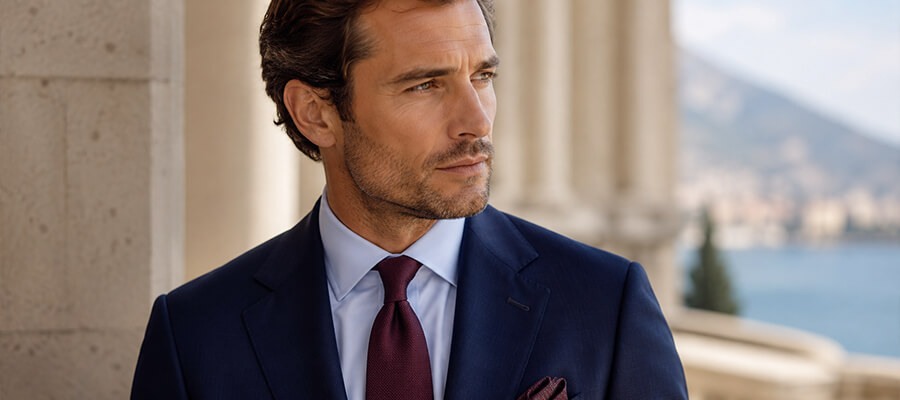
Men's tie guide
Men's ties: how to choose colour, pattern and proportions
A tie draws the eye to the centre of an outfit. Colour, pattern, width, fabric and knot should therefore be chosen in relation to the shirt, jacket, collar and occasion.
Choose the shirt and suit first
The tie completes the combination rather than defining it alone. Start with the suit or jacket, then the shirt, and finally choose a tie that either repeats one colour or introduces a controlled contrast.
When two garments are patterned, use a tie with a clearly different scale or choose a solid colour.
Reliable colour combinations
White shirt
The most flexible base. Navy, burgundy, green, grey and patterned ties all work according to the suit.
Light-blue shirt
Navy and burgundy create classic contrast. Brown and green produce a softer, more natural palette.
Pink shirt
Navy, burgundy and deeper purple tones can create a balanced result.
Striped or checked shirt
Use a solid tie or a pattern whose scale is clearly different from the shirt.
Pattern scale
| Shirt | Tie | Guideline |
|---|---|---|
| Solid | Solid or patterned | The easiest and most flexible combination. |
| Fine stripe | Solid or larger pattern | Avoid a tie with stripes of the same width. |
| Small check | Solid or broad geometric pattern | Keep the shared colours controlled. |
| Strong pattern | Solid | Let the shirt remain the main visual element. |
Width, lapels and body proportions
Tie width should relate to jacket lapels and the wearer's build. A very narrow tie can look disconnected from broad lapels, while a very wide tie can dominate a slim silhouette. The objective is visual balance rather than one universal measurement.
Fabric and season
Silk
Smooth or textured silk is the traditional choice for business and formal wear.
Wool
A warmer, more textured option for autumn, winter and softer tailoring.
Knitted or cotton tie
A more relaxed construction for business casual and seasonal outfits.
Choose the knot for the collar
A wider collar opening can accept a fuller knot, while a narrow collar usually works better with a compact knot. The knot should fill the space without pushing the collar points apart.
Compare collar structures in the men's shirt collar guide.
Common mistakes to avoid
- Using the same pattern scale on shirt and tie.
- Choosing a tie that is visibly wider or narrower than the jacket proportions.
- Combining too many strong colours in one outfit.
- Wearing a casual tie fabric with a highly formal suit without a deliberate reason.
- Copying the pocket square exactly instead of coordinating it.
Frequently asked questions
Which tie works with a light-blue shirt?
Navy and burgundy are classic choices. Brown, green and patterned ties can work when they coordinate with the suit.
Can I wear a patterned tie with a patterned shirt?
Yes, when the pattern scales are clearly different and the colour palette remains controlled.
Should the tie match the pocket square?
They should coordinate but do not need to use identical fabric or pattern.
Complete the combination with balance
Start from suit and shirt, then select a tie whose colour, scale and width support the entire outfit.
Extra DISCOUNT 10% OFF
Use code: RESTYLE - minimum purchase 99 EUR
Use code: RESTYLE
minimum purchase 99 EUR
Login and Registration Form