


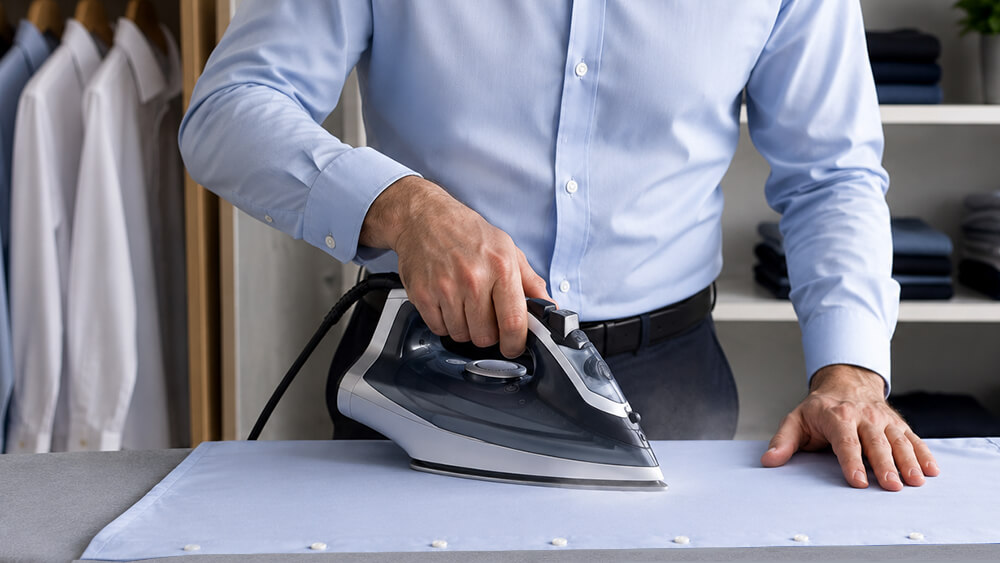
European shirt care guide
How to iron a men's shirt step by step
A well-ironed shirt makes the fabric, fit and construction look cleaner. Working from the smaller sections to the larger panels helps prevent already finished areas from becoming creased again.
Before you begin
Read the care label and use a temperature suitable for the fabric. Excessive heat can make fibres shiny, alter colours or damage delicate materials and finishes.
European care labels commonly use an iron symbol with dots to indicate the permitted heat level. Follow the garment label and the iron manufacturer's instructions rather than assuming one temperature for every cotton shirt.
Clean iron
The soleplate should be free from residue that could mark the fabric.
Stable board
A firm, well-covered surface at a comfortable height improves control.
Steam or water
Use only when compatible with the fabric and iron instructions.
Suitable hanger
Hang the shirt immediately to preserve the result.
The correct sequence
1
Collar and shoulders
Open the collar and work from the points toward the centre, then move to the yoke and shoulders.
2
Sleeves and cuffs
Align the sleeve seams, open the cuffs and keep the iron away from the buttons.
3
Front and back
Iron each front panel and then the back while keeping the fabric smooth.
4
Prepare for folding
Fasten enough buttons to keep the front aligned and place the shirt face down.
5
Fold symmetrically
Fold both sides evenly, position the sleeves and bring the lower section upward.
6
Final finish
Turn the folded shirt and use very light pressure on the front before storing it.
Detailed illustrated sequence
The six individual pages show each operation with the original step images:
Collar, cuffs and buttons
- Iron the collar flat and avoid creating an unintended crease along the fold.
- Open cuffs fully and work on both sides when the care label permits it.
- Iron around buttons rather than pressing directly on them.
- Use the pointed end of the board for shoulders and the yoke.
- Move the iron continuously and avoid leaving it stationary on the fabric.
Hang or fold?
Hanging is the simplest way to preserve a freshly ironed shirt. Folding is useful for drawers, shelves and travel, but it must be symmetrical and the collar should not be compressed by heavier garments.
Common mistakes
Too much heat
Can shine, discolour or damage the fabric.
Ironing over buttons
Can mark the fabric or damage the fastening.
Ignoring the seams
Misaligned seams create unwanted creases in sleeves and side panels.
Storing immediately under weight
Can flatten the collar and recreate folds.
Frequently asked questions
Which part of the shirt should I iron first?
Begin with the collar and smaller structured areas, then move to sleeves, cuffs and the larger body panels.
Should the shirt be completely dry?
A slightly damp shirt is often easier to iron. Use steam or a light mist only when permitted by the fabric and appliance instructions.
Is it better to hang or fold the shirt?
Hanging generally preserves the result more easily. Fold it when storage or travel requires it.
Follow the sequence without rushing
Correct temperature, aligned seams and an orderly progression produce a cleaner result with less repeated work.
Extra DISCOUNT 10% OFF
Use code: RESTYLE - minimum purchase 99 EUR
Use code: RESTYLE
minimum purchase 99 EUR
Login and Registration Form